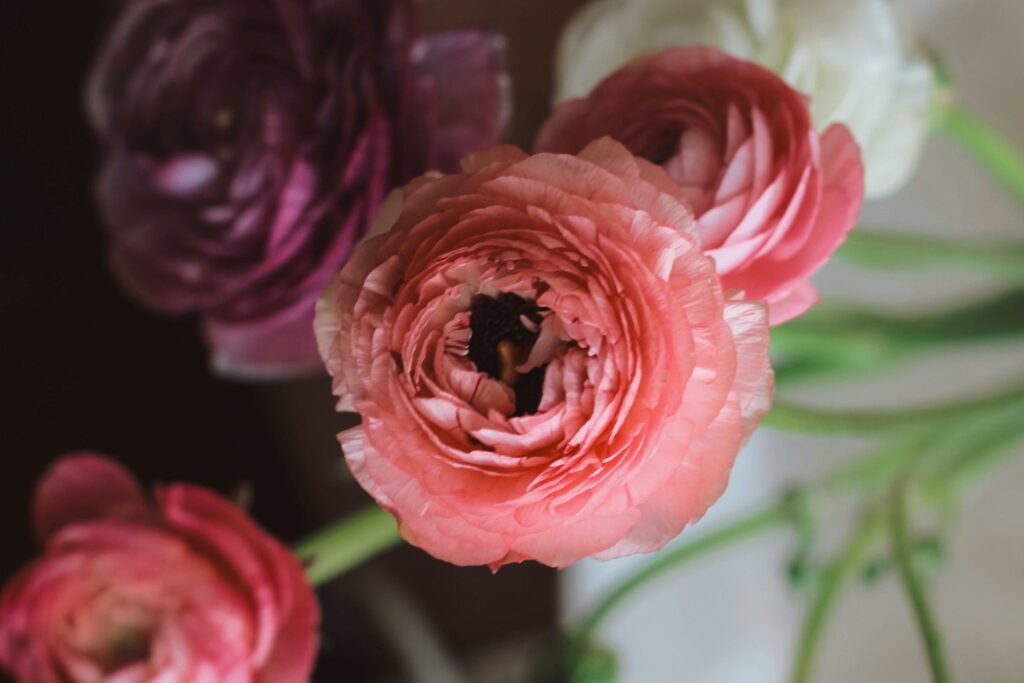

Why a florist’s unexpected response to a question about making flowers last longer on an American talk show struck such a chord with millions – and what it tells us about beauty, time and the business of living.
When Ross Mathews asked floral designer Kristen Griffith-VanderYacht how to make flowers last longer, nobody could have anticipated quite the answer he and Drew Barrymore were about to receive.
The conversation was taking place on The Drew Barrymore Show, where Kristen was talking about his book, Flower Love, and sharing tips on how to upgrade everyday blooms.
The discussion turned to the familiar household tricks people use to prolong the life of cut flowers. How do you keep them fresh? How do you make them last? Does adding an aspirin, a penny, or a splash of vodka to the water actually work?
Rather than offer another practical flower-care tip, Kristen reached across the table, took Drew’s hands, and delivered a little life lesson.
“Flowers are not supposed to last,” he told her. “Listen to me… They’re not supposed to last. Their job is to help us to stay in the present, okay? They grow, they blossom, they thrive, and then they’re gone.”
He went on to explain that we need to stop and be in the moment while they are here—otherwise, we blink, and suddenly they are gone.
It was a simple observation, delivered with warmth and conviction. Yet the short clip travelled far beyond the usual audience for floristry, becoming one of those unexpectedly emotional moments that people wanted to share.
And perhaps the reason is that, although Kristen was talking about flowers, he was really talking about life.
The beauty is in the fleeting nature of things
Think about how we buy flowers.
We choose the freshest stems, look for the tightest buds, check the petals and hope that our arrangements will last as long as possible. We change the water, trim the stems, add flower food and move the vase away from direct sunlight.
We do everything we can to extend their lives.
And quite rightly. Nobody wants to spend money on flowers that fade prematurely.
But perhaps we have become so preoccupied with how long flowers last that we sometimes forget why we buy them in the first place.
We don’t buy flowers because we expect them to become permanent fixtures in our homes. We buy them because they make us feel something. They brighten a room, lift our spirits, mark an occasion, communicate affection or bring comfort when words are difficult to find.
Their value isn’t determined by how many days they remain in a vase.
It is determined by what they bring to the days they are here.
And that is a rather wonderful distinction.
A message that reaches far beyond flowers
Perhaps the reason this particular video has travelled so widely is that it isn’t really about flowers at all.
It is about us.
We spend so much of our lives looking forward. Waiting for the weekend, the holiday, the next promotion, the house move, the retirement, the moment when everything finally falls into place.
We photograph experiences rather than fully experiencing them. We worry about tomorrow while barely noticing today. We sometimes postpone happiness until circumstances are just right.
And in doing so, we risk missing the very things we are working so hard to achieve.
The florist’s message offers a gentle challenge to that way of thinking.
A flower doesn’t spend its brief existence worrying about how long it has left. It grows, opens and gives everything it has to the moment in which it exists.
There is something wonderfully uncomplicated about that.
Of course, human life is considerably more complicated than the life of a flower. We have responsibilities, anxieties, ambitions and relationships that require care and commitment. But perhaps the lesson isn’t to stop planning for tomorrow. It is to make sure that tomorrow doesn’t consume today.
Why the message feels so emotional
There is another reason the video has struck such a chord: flowers are already woven into some of the most important moments of our lives.
We give them when we fall in love, when we celebrate a birth, when somebody achieves something extraordinary and when we want to say thank you.
We send them when somebody is ill, when a relationship ends, when somebody dies and when there simply aren’t words enough to express how we feel.
Flowers accompany us through beginnings, endings and everything in between.
They are present at weddings and funerals, at celebrations and moments of profound sadness. They are often the physical expression of an emotion we struggle to articulate.
And perhaps that is why the idea of flowers being temporary feels so meaningful.
They remind us that life itself is made up of moments that cannot be held indefinitely.
A birthday passes. Children grow up. Relationships change. People come and go. Even the most extraordinary experiences eventually become memories.
We cannot keep everything. But we can appreciate it while it is here.
An important message for the floristry industry, too
There is also something particularly interesting about this moment from the perspective of the floral industry.
For years, much of the conversation around buying flowers has focused on longevity, value for money, flower food, conditioning techniques and vase life.
These things matter enormously. Florists have a responsibility to provide quality, freshness and good advice. Nobody is suggesting otherwise.
But the viral video reminds us that there is a bigger story to tell.
Flowers are not simply a product with a limited shelf life. They are an experience, an emotional connection and, arguably, one of the simplest ways we have of bringing a little beauty into everyday life.
The industry sometimes talks about flowers in terms of varieties, colours, seasons, availability and price. All essential considerations, but none quite capture the emotional reason people buy them.
Perhaps we should spend more time telling that story.
We should remind people that they don’t need a wedding, an anniversary or a special occasion to buy flowers. They don’t need permission to put a beautiful bunch on the kitchen table, brighten their workspace or treat themselves on an otherwise ordinary Tuesday.
In fact, perhaps the ordinary Tuesday is the perfect reason.
Perhaps we should stop asking flowers to last forever
There is an irony in the fact that a message about the fleeting nature of flowers has been shared so widely and so enduringly across social media.
A few seconds of television have become a moment that people want to preserve, replay and pass on.
But perhaps that is fitting.
The video itself is temporary in the grand scheme of things. The social media algorithms will eventually move on. Another clip will capture people’s attention. Another conversation will become the subject of the day.
Yet the thought behind it is timeless.
We cannot stop flowers from fading. We cannot stop time from passing. And we cannot make every beautiful thing last as long as we would like.
What we can do is pay attention.
Notice the first tulip opening. Enjoy the scent of a rose. Appreciate the colours of a seasonal arrangement. Buy the flowers, put them somewhere you can see them and enjoy every day they are there.
And perhaps apply the same thinking to the rest of our lives.
Don’t wait until everything is perfect to enjoy what you already have. Don’t save all the good things for another day. Don’t become so focused on making life last that you forget to actually live it.
Because flowers were never supposed to last forever.
Perhaps their greatest gift is that they remind us that we don’t have to, either.