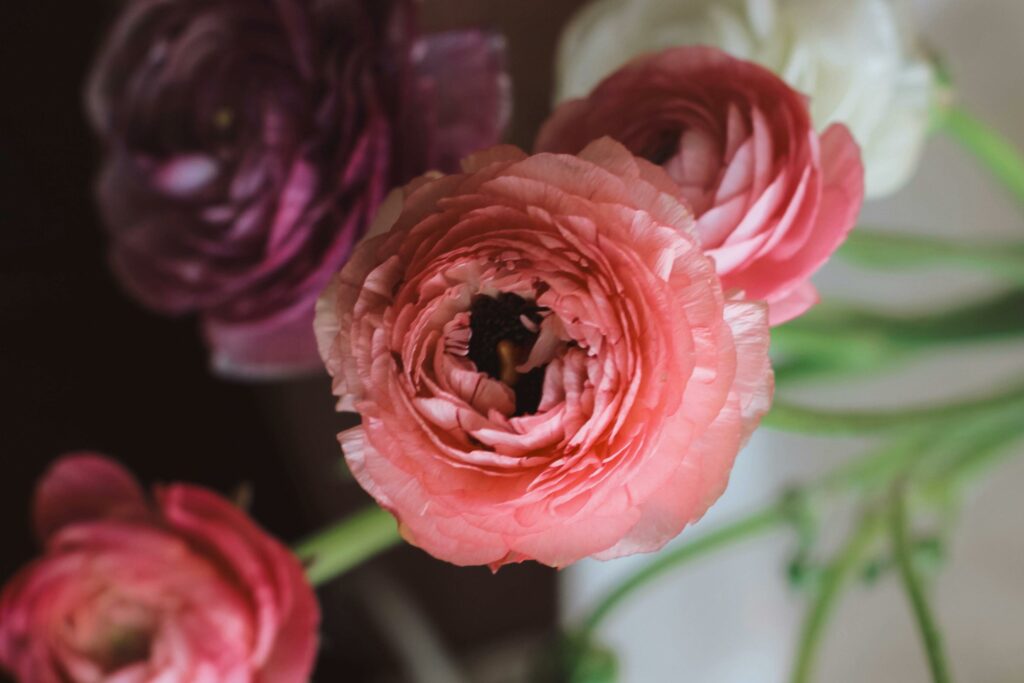

Fashion’s most enduring muse was never a model. She was a mother. And she always carried flowers.
Inside the most beautiful, most ancient, most radical act of devotion the world has ever known
There is a photograph — you have seen it, or something very like it — of a woman holding flowers. She is standing in a doorway, or a field, or a market, or a temple courtyard. The light is doing something extraordinary to her face. The flowers are enormous, or impossibly fragrant, or a colour that seems to belong to another order of reality altogether. And there is something in the way she holds them — not displaying them, exactly, but offering them, her hands slightly open, palms up — that makes the photograph impossible to look away from.
Every culture on earth has produced this image. Every culture on earth has needed to.
The mother and the flower. The oldest pairing in the visual history of the world, and still, somehow, the most powerful. Before there were photographers to capture it, there were painters. Before painters, there were sculptors. Before sculptors, there were the people who pressed actual flowers into the hands of carved figures and painted goddesses and laid petals across the bodies of the beloved dead, saying with a handful of blossoms what they could not bring themselves to say with words.
This season — this always, this forever — the flower is everywhere. And it has never really been about fashion at all. It has always been about her.
THE GODDESS WORE LOTUS
Long before the first couture house opened its doors on Avenue Montaigne, the world’s most powerful women were already dressing in flowers.
Isis — the Egyptian goddess whose cult was arguably the most extensive in the ancient world, whose temples stretched from the Nile Delta to the coast of Britain, whose image appeared on everything from monumental carved temple walls to the smallest household amulet — wore the lotus. Not as accessory. Not as embellishment. As identity. The blue water lily (Nymphaea caerulea), opening its petals at dawn from beneath the dark surface of the Nile, was Isis herself: the mother who sinks into darkness and rises again, who searches and finds and reassembles and breathes life back into the world.
Consider the sheer iconographic power of this image. We are talking about a civilization that lasted — actively, continuously, producing extraordinary art and architecture and theology — for more than three thousand years. Longer than the gap between us and the fall of the Roman Empire. And for the entirety of that time, in every medium available to Egyptian artists — carved limestone, painted papyrus, cast gold, woven linen, fired faience — the supreme mother goddess appeared with her flower. The lotus was not decoration. It was information. It told you, immediately and precisely, what kind of love this was: the kind that rises. The kind that does not stay submerged. The kind that opens, regardless.
“The lotus grows in mud,” notes Dr. Layla Hassan, an Egyptologist and cultural historian whose forthcoming book on divine feminine iconography in the ancient world has been described by colleagues as definitive. “The Egyptians understood this perfectly. The goddess gives beauty from impossible circumstances. This is not merely poetry. This is a complete philosophy of maternal love.”
We would call it effortless. They called it divine. The distinction may be smaller than we think.
WHAT LAKSHMI KNEW
If Isis is the mother of the ancient Mediterranean — the goddess of fierce searching love, of reassembly after catastrophe — then Lakshmi is the mother of abundance. The mother whose presence makes everything richer, more golden, more possible.
She sits on a pink lotus in every representation produced across three millennia of Indian art. She holds lotus blossoms in two of her four hands. Gold coins fall from a third. A fourth is raised in blessing. Around her, elephants shower her with water, and the water becomes auspicious, because everything Lakshmi touches becomes auspicious. This is simply what she does.
The lotus she holds is doing specific, serious work. Nelumbo nucifera — the sacred pink lotus, a plant of extraordinary scientific interest (its flowers can thermoregulate, maintaining a temperature of 30–36°C even in cold conditions, a fact that continues to astonish botanists) — grows in conditions of considerable adversity. Anaerobic mud. Stagnant water. Difficult light. And from these conditions it produces a flower of such perfection, such architectural precision, such fragrant generosity, that it has been used in the formal vocabulary of beauty across Asia for four thousand years.
What Lakshmi knew — what the flower says, in her hands — is that abundance is not a product of easy circumstances. It is a choice, and a practice, and a quality of character. The most generous mothers we have known have not been the ones who had the most. They have been the ones who gave from whatever they had, completely, without calculation.
The lotus, in Lakshmi’s hands, is a theory of generosity.
KALI’S HIBISCUS: ON THE FEROCITY OF LOVE
We would be remiss — actually, we would be doing the subject a significant disservice — if we confined our survey of the divine maternal to the tender and the abundant.
Some mothers are not gentle. Some love is not soft. And some flowers are not subtle.
Kali — the Hindu goddess who dances on the corpse of her husband, who wears a garland of severed heads, whose tongue is permanently extended in a gesture of fierce, consuming appetite, who is simultaneously terrifying and beloved across the Bengali and Assamese traditions that have produced some of the most sophisticated devotional art in the world — takes red hibiscus.
The China rose (Hibiscus rosa-sinensis), dark red, blood-coloured, its petals wide open and its central column of stamens thrust forward with the confidence of something that has nothing to hide: this is Kali’s flower. It announces what it represents without apology. A love so complete it becomes ferocious. A protection so absolute it will destroy whatever threatens its object. A mother who does not flinch.
“There is a misunderstanding in Western readings of Kali,” says the Kolkata-based artist Priya Mukherjee, whose large-format paintings of Kali — rendered in the traditional Bengali pata style but at the scale of billboard advertising — have been exhibited from Mumbai to New York. “People see the violence and think: destruction. But the devotees see something else entirely. They see a mother who will do anything. Who will unmake herself, who will stand in fire, who will wear the evidence of everything she has destroyed on her body, rather than allow harm to come to her children. The hibiscus says this. It says: I am here. I am not afraid. Nothing reaches you through me.”
In this context, the deep red of the hibiscus is not alarming. It is reassuring.
It is the most honest flower in the world.
GUANYIN, AND THE ART OF THE OPEN HAND
We have always been drawn to the image of Guanyin — and we do not think this is accidental.
She is the Bodhisattva of compassion. The figure who, in Chinese, Japanese, Korean, Vietnamese, and pan-Asian Buddhist tradition, fills the role of universal mother: the one who hears the cries of all beings and responds. Her name, Guanshiyin, means “she who perceives the sounds of the world.” She perceives them all, simultaneously, and she does not rank them in order of worthiness before responding.
She stands on a lotus throne. She holds a willow branch dipped in a lotus-shaped vessel of sacred water. And she gives — without condition, without preference, without running out. The lotus in her hands says what every mother’s open hands say: here. Take what you need. There is more.
The Tang Dynasty limestone carvings of Guanyin — some of the most beautiful objects ever made in any medium anywhere in the world, their fluid stone drapery suggesting movement, the carved faces achieving a serenity that is not blankness but fullness — were produced by artists working in the service of an image that had been arriving in China from India for centuries, each culture adding its own inflection without losing the essential quality. The lotus traveled with her. It is still traveling.
Contemporary Chinese luxury brand aesthetics — the growing conversation between traditional iconography and modern design vocabulary in the work of designers including Huishan Zhang and Uma Wang — have engaged with the Guanyin image in ways that feel both reverent and genuinely new. The open hand. The lotus. The quality of presence that does not demand anything in return.
“It is the anti-logo,” says one fashion historian who prefers not to be named in this context. “The Guanyin doesn’t need you to recognise her. She is there regardless. This is the ultimate luxury. Not to need to be seen.”
THE ROSE: AN AUTHORITATIVE HISTORY
The rose has been fashion’s flower — and the mother’s flower, and the goddess’s flower, and the mourner’s flower — for longer than fashion has had a name.
Begin in Persia, where the Rosa damascena — the Damask Rose, developed in the gardens of what is now Syria and cultivated across the Persian world with an intensity that amounted to civilisational preoccupation — was understood as paradise made botanical. The Persian garden (chahar bagh, the fourfold garden) was built around the rose: water channels, shade trees, and the rose at the centre of everything, its fragrance rising in the evening air over the sound of the fountains. The goddess Anahita — patroness of water, fertility, and wisdom, one of the ancient world’s most extensively worshipped divine feminine figures — was associated with roses and water flowers. Where Anahita’s blessing fell, things grew.
The Sufi poets — Rumi, Hafiz, Sa’di — returned to the rose so compulsively that it became almost a linguistic embarrassment: how many poems can one civilisation write about one flower? (An almost unlimited number, it turns out, because the rose kept yielding new meanings.) In their hands, the rose became the primary image of divine love: something burning, fragrant, thorned, and irresistible. The nightingale who sings endlessly to the rose. The rose who blooms in serene, radiant completeness. The child who calls. The mother who is.
The rose arrived in European Christian iconography through Byzantine intermediaries and took root with extraordinary speed. The Virgin Mary — the supreme maternal figure of Western Christendom, the human woman whose act of consent became, in Catholic theology, the hinge on which all of creation turned — was named Rosa Mystica in the Litany of Loreto. The Rosary — from rosarium, rose garden — was her primary devotional form. Every bead was a rose. Every decade of prayer was a garland. The act of devotion was, also, an act of flower arranging.
The medieval European rose was a different rose from the Persian rose and a different rose from the classical rose, but it was doing the same essential work: providing a language for a love so large that ordinary language could not hold it.
Today, in the ateliers of the great fashion houses, the rose continues its work. Dolce & Gabbana’s Sicilian baroque florals — enormous, exuberant, unapologetically excessive — make the rose a statement about the southern Italian maternal culture that has always been their primary inspiration: the mother in the kitchen, the mother at the altar, the mother whose love is so large it needs to be expressed at operatic volume. Valentino’s rose red — that specific, exact, trademarked rosso Valentino — is the colour of the flower at its most confident, its most unconditional. Alexander McQueen’s dark, deconstructed roses were the flower at its most complex: beauty and darkness, love and its cost, the mother who grieves.
The rose is not a trend. The rose is a position.
THE MARIGOLD: FASHION’S MOST UNDERRATED FLOWER
There is a conversation happening in fashion about the marigold, and it is long overdue.
For too long, the marigold — Tagetes erecta, the Aztec marigold, the cempasúchil, the genda phool — has been overlooked in favour of its more socially prestigious neighbours: the rose, the peony, the orchid. This is a mistake, and the world’s most sophisticated cultures have always known it.
In India — where the aesthetic conversation about flowers has been ongoing for four thousand years and shows no signs of losing momentum — the marigold is the working flower of devotion. It does not aspire to the rose’s glamour or the lotus’s transcendence. It shows up, in quantities that would give a wholesale florist pause, at every occasion of spiritual significance: goddess festivals, wedding celebrations, temple offerings, the daily morning prayer. Its orange and yellow — saturated, warm, unambiguous — are the colours of auspiciousness itself. To walk into a space decorated with marigold garlands is to walk into a space that has been deliberately made auspicious. Someone chose this for you. Someone spent hours threading these flowers. Someone wanted this to be beautiful, for you.
In Mexico, the marigold is even more serious. The cempasúchil is the flower of Día de los Muertos — the November ceremony in which the dead return to visit the living, guided home by the flower’s extraordinary volatile fragrance, scattered in petal-paths from the graveyard to the household altar. Here the marigold is not merely auspicious. It is cosmological. It is the flower that keeps the bond between mother and child alive after death. The petals scattered on a November altar say: even now, you can find your way back to us. Even now, we remember how you smell.
The Aztec goddess Xochiquetzal — “Precious Flower,” the patron of beauty, craft, and the protection of mothers in labour — wore flowers in her elaborate headdress and was attended by butterflies and hummingbirds. She is, in some readings, the most fashion-forward goddess in the pre-Columbian world: a divine being whose relationship with beauty was understood as a form of serious power rather than frivolous decoration.
We recognise her.
The marigold has been appearing on the runways with increasing confidence: in the work of Simone Rocha, who has consistently engaged with the iconography of Irish Catholic devotion and its complex relationship with flowers and feminine power; in the orange-and-gold palette of Maria Grazia Chiuri’s florally engaged collections for Dior, which draw on both European meadow traditions and a distinctly global conversation about the maternal and the sacred; in the botanical prints of younger designers who are finding in the marigold’s directness and generosity a counter-statement to the pallid, ironic aesthetics that dominated the previous decade.
The marigold does not do irony. This is its greatest virtue.
JAPAN, AND THE BEAUTY OF WHAT ENDS
There is no fashion culture in the world that has thought more seriously about beauty and time than Japan’s.
The cherry blossom — sakura, the flower of the national psyche, the subject of more poems and paintings and lacquer boxes and silk bolts and ceramic bowls than any other single botanical subject in the history of Japanese art — is beautiful because it does not last. This is not incidental to its beauty. This is its beauty. Two weeks of extraordinary flowering, then a fall of petals that the Japanese call hanafubuki — flower blizzard — and then the green leaves of ordinary summer, and it is over.
The Japanese concept of mono no aware — the bittersweet awareness of impermanence, the particular emotional resonance of beautiful things that are already in the process of becoming something else — was built around this flower. And the maternal connection is precise and unambiguous. The Shinto goddess Konohanasakuya-hime, the Blossoming Flower Princess, is both the goddess of the sakura and one of Japan’s most important maternal figures: she who gave birth inside fire, whose love was proved by its capacity to survive destruction, whose children emerged from the flames as themselves, unchanged, because the mother’s love was true.
Japanese fashion designers have engaged with the sakura with the same seriousness that their culture has always brought to it. Rei Kawakubo’s relationship with the flower is oblique and philosophical: the absence of the flower as statement, the silhouette that suggests bloom without depicting it, the black that contains all the colours of the cherry blossom’s aftermath. Issey Miyake’s pleats — those extraordinary, permanent-memory pleats that hold their shape regardless of what you do to them — are, in some lights, a meditation on the sakura: beauty that is also structure, impermanence that has been folded into something that endures.
Junya Watanabe has worked with sakura prints that dissolve at the edges, petals becoming abstraction, the image performing its own impermanence. Undercover’s Jun Takahashi has made the blossom strange — enlarged, distorted, printed on unexpected substrates — in ways that honour the flower’s strangeness more honestly than any straight reproduction could.
The Japanese fashion industry understands something that the rest of the world’s fashion industry is still learning: that the most beautiful things are the ones that know they will end. That the garment that acknowledges its own future as a vintage piece, a beloved worn thing, an object that will eventually become rags and then become nothing, is more beautiful than the garment that pretends to permanence.
The sakura knows this. The Japanese have always known this. The best Japanese fashion says this.
THE PROTEA AND THE NEW BEAUTY
The conversation about what constitutes a beautiful flower — and, by extension, what constitutes beautiful maternal love — is being written right now, in the work of contemporary African designers, artists, and cultural practitioners who are bringing the flowers of the southern African landscape into a global aesthetic conversation from which they have been too long absent.
The King Protea (Protea cynaroides) is South Africa’s national flower, and it is unlike anything in the European floral canon. It produces a flower head thirty centimetres across, globe-like, its mass of central florets surrounded by a ring of stiff, pointed bracts in colours ranging from cream to deep rose. It looks like something from another planet. It requires fire to reproduce — its seeds, sealed in protective cones, will not germinate until heat above 60°C breaks the cone open, which means that the protea’s new generation emerges from burned ground, from catastrophe, from the aftermath of everything the landscape has been through.
You will understand why this flower has been associated, in southern African cultural traditions, with the specifically maternal quality of endurance-through-destruction. The protea does not bloom despite the fire. The fire is the mechanism. The fire is what makes the next generation possible.
South African designers — Thebe Magugu, Rich Mnisi, Sindiso Khumalo — have been engaged in a sustained, rigorous, and visually extraordinary conversation with their botanical and cultural inheritance. Magugu’s collections have explored the relationship between female resistance, cultural memory, and the natural world of the Cape with an intellectual seriousness that has made him one of the most significant designers working anywhere in the world. Rich Mnisi’s engagement with Tsonga decorative traditions — beadwork, textile, pattern — places the vibrant, dense, unapologetically coloured aesthetic of southern African feminine craft in dialogue with contemporary international fashion in ways that feel neither assimilated nor confrontational but genuinely, generously sovereign.
The protea, in this conversation, is not an exotic specimen. It is a home flower. It is the flower of the maternal landscape. And it is, finally, receiving the attention it has always deserved.
WHITE FLOWERS: A THEORY
There is a specific quality of white that flowers achieve — not the white of paper or paint or bleached fabric, but the white of a gardenia, or a jasmine, or a lotus, or a white rose — that no other material quite manages. It is a white with warmth in it, a white that seems to generate its own light, a white that is present in a room even when you are not looking at it.
This white has been associated with the maternal across cultures and centuries with a consistency that amounts, essentially, to a law.
In Japanese tradition, the white chrysanthemum is the flower of the imperial house and of enduring maternal love: the mother who maintains her dignity and her beauty through the cold months, who does not need warmth to open. In the Christian tradition, the white Madonna Lily (Lilium candidum) appears at the moment of the Annunciation — the moment when a woman is told she will be a mother — in virtually every painting of this scene in the history of Western art. In West African Yoruba tradition, white flowers are the offering to Yemoja, the ocean mother: white like deep water, white like the milk of the source, white like everything before it becomes specific.
In Thai culture, the white jasmine garland given by children to their mothers on Mother’s Day is white specifically: white for purity, white for the cleanness of the debt a child owes the person who gave them life.
White flowers. The colour of milk. The colour of the first thing. The colour of the mother before you were old enough to know that she was also a person with a colour of her own.
The great white dress moments in fashion history are, we would argue, always also about this: the bridal white that precedes motherhood, the christening white of new beginnings, the white of the communion dress, the white of the debutante’s first appearance in the world. White as potential. White as the statement that everything is still possible.
The white flower says: here is the beginning. Here is where it starts.
THE CARNATION AND THE WOMAN WHO GAVE IT EVERYTHING
We should talk about Anna Jarvis.
In 1914, Anna Jarvis — a woman who had watched her own mother’s lifelong advocacy for maternal health and peace with a devotion that bordered on the religious — succeeded in convincing the United States Congress to designate an official Mother’s Day. She had been campaigning for years. She had written thousands of letters. She had spent money she did not have.
She chose the white carnation as the day’s flower. Her mother’s favourite. White for purity, white for truth, white for the particular quality of a mother’s love that Anna believed — with the intensity of someone who has made an idea the entire project of their life — could not be adequately expressed by any other means.
Within a decade, she was fighting the flower industry.
“A carnation,” she told reporters in the 1920s, with the precision of someone who has arrived at a clear position after careful thought, “does not represent motherhood any more than a card sent by a secretary does.” She objected to the commercialisation of the day she had created, to the reduction of a genuine and serious act of devotion to a transaction. She fought the confectionery companies. She fought the greeting card manufacturers. She fought the florists.
She died in 1948, in a sanatorium, without money, having spent everything she had on the campaign. The flowers kept selling.
We tell this story not to be sad about it — though it is sad — but because it is, in its way, the most honest version of the story we have been telling throughout this feature. The flower chosen out of love. The love turned into commerce. The commerce becoming, in time, its own kind of tradition, its own kind of genuine feeling, its own species of imperfect but real communication between people who cannot quite find the words.
Anna Jarvis was right that the carnation alone is insufficient. She was also, perhaps, not fully right that the gesture is therefore worthless. The flowers keep selling. People keep buying them. And the mothers keep receiving them, and something passes between the giver and the receiver that is not nothing, even if it is not everything.
The carnation, white or red, modest and affordable and available at the petrol station: it is still, in its way, doing the same work as the lotus in Isis’s temple, the jasmine in Guanyin’s hands, the protea on the burned hillside above Cape Town. It says the thing that needs saying. It says: I know where I came from. I have not forgotten. Here is the most beautiful thing I could find for you.
THE GREAT MOTHERS AND THEIR FLOWERS: A SEASONAL GUIDE
The world’s divine mothers, and what they carry:
ISIS (Egypt) — Blue lotus (Nymphaea caerulea). The original. The mother who searches through darkness and rises. For the mother who has been through the worst and is still here.
LAKSHMI (India) — Pink lotus (Nelumbo nucifera). Abundance, grace, the generous giving of beauty. For the mother whose presence makes everything richer.
KALI (India) — Red hibiscus (Hibiscus rosa-sinensis). Fierce, unconditional, the love that destroys what threatens. For the mother who has protected you from things you didn’t even know were threats.
GUANYIN (China/pan-Asian Buddhism) — White lotus. Compassion without preference, the open hand, the response to every cry. For the mother who never made you feel like your needs were too much.
DEMETER (Greece) — Red poppy (Papaver rhoeas). Grief that keeps searching, the love that makes winter when it is lost, the love that brings spring when it returns. For the mother who has been through grief and given you spring regardless.
MARY (Christian tradition) — White lily (Lilium candidum) and rose. The moment of yes. The love that said yes to everything that would be asked of it. For the mother who said yes before she knew what she was agreeing to.
YEMOJA (Yoruba/West Africa) — White flowers, any species. The source, the ocean, the mother before specific. For the mother whose love is so fundamental you cannot remember a time before it.
OSHUN (Yoruba/West Africa) — Yellow flowers, honey-coloured. Sweetness, the river, the love that flows. For the mother who made joy seem easy even when it wasn’t.
XOCHIQUETZAL (Aztec/Mexica) — Marigold (Tagetes erecta). The patron of beauty and mothers in labour, the guardian of makers. For the mother who saw you working on something difficult and never once told you it wasn’t worth it.
KONOHANASAKUYA-HIME (Japan/Shinto) — Cherry blossom (Prunus serrulata). Beauty that persists through fire, love proved by its capacity to endure the worst. For the mother whose love you only fully understood after you had faced your own version of the flames.
PACHAMAMA (Andean traditions) — Cantuta (Cantua buxifolia) and wildflowers. The earth itself as mother, the love that is the condition of existence. For the mother who is so fundamental to your world that you have only recently begun to understand what the world would be without her.
CODA: WHAT THE FLOWER KNOWS
The great designers have always understood — the great ones, the ones whose work outlasts the season — that fashion at its most serious is not about clothes at all. It is about the body that wears the clothes. It is about what the body has been through, and what it has survived, and what it loves, and who it comes from.
Every woman who has ever stood at a cutting table and drawn a pattern that would have to accommodate a real human body — its asymmetries, its histories, its unique and particular presence in the world — has been, in some sense, working in the tradition of the lotus. Taking the difficult circumstances. Producing something of beauty regardless.
The mother, across all the traditions we have visited in this feature — Egyptian, Hindu, Japanese, Mexican, West African, Greek, Christian, Andean, Celtic, and every tradition we have not had space to visit — is the original designer. She takes the available materials. She works with what she has. She produces something that did not exist before and that contains, in some essential way, her particular knowledge of what beauty requires of a person.
The flower, offered to her, says: we see this. We know what this costs. We find it extraordinary.
And she receives it, and she says: thank you. Now, here is something I made for you.
The conversation has been going on for sixty thousand years. It shows no signs of ending. This season, as always, it is the most important conversation happening anywhere in the world.
The flower endures. The mother endures. And fashion — at its best, at its most serious, at its most honest about what it is actually trying to do — has always known that its deepest ambition is not to dress the body but to honour it.
The most beautiful thing anyone ever made was not a dress.
It was a person.