
There is a particular kind of ambition that announces itself quietly. No fanfare, no venture capital, no disruptive manifesto — just a small boutique on a narrow street in Sheung Wan, stocked with flowers arranged in a manner that made passers-by stop and look twice. When Diane Nittke opened Ellermann Flower Boutique in 2011, she was not setting out to build a brand. She was setting out to prove a point: that Hong Kong deserved better flowers.
Over the thirteen years that followed, she proved it comprehensively.
A German Eye in a Chinese City
Nittke brought an unusual pedigree to the flower business. Originally from Germany, she arrived in Hong Kong with a background spanning creative direction, marketing, and event design — disciplines that, in retrospect, were perfectly suited to reimagining what a florist could be. She had an outsider’s clarity about what was missing from the city’s floral culture and an insider’s understanding, developed over years of living in Hong Kong, of what its clientele actually wanted.
The boutique she created was named after her grandmother — a detail that speaks to the sensibility at its core. Ellermann was never conceived as a corporate enterprise but as something more personal: a continuation of a European tradition of taking flowers seriously, of treating them not as decorative filler but as objects of genuine aesthetic consideration. Her philosophy was to bring the simple joy of flowers to the everyday, to resist the notion that beautiful blooms required a special occasion to justify them.
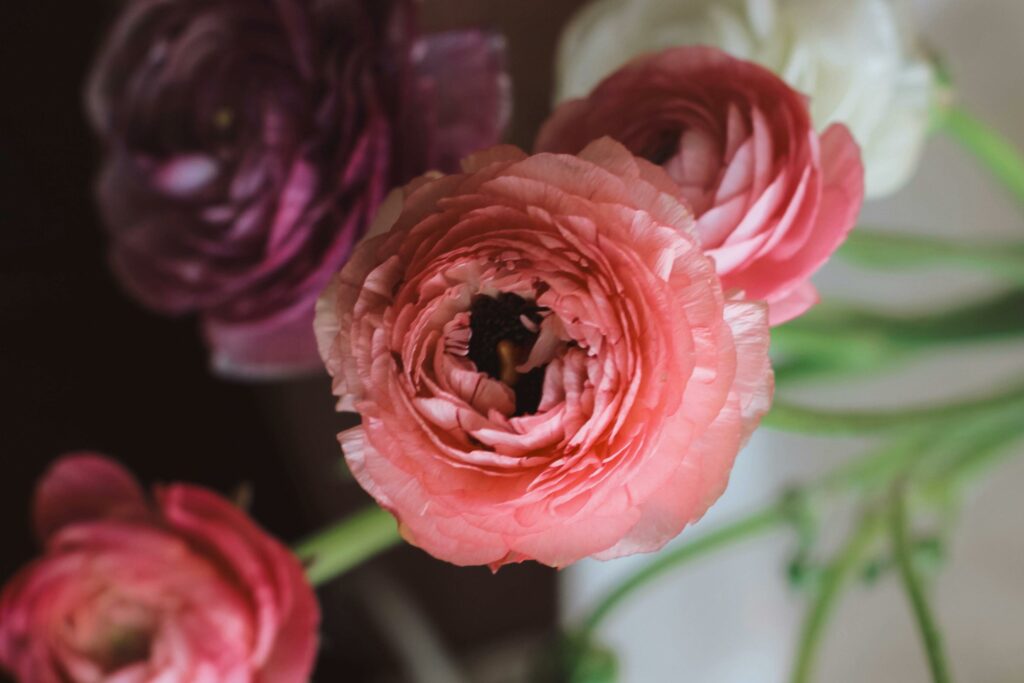
The design language she developed was unmistakably continental. Arrangements were stunningly layered, textured, and elegant — each punctuated, as the brand put it, with an element of the unexpected. Where many Hong Kong florists favoured symmetrical, formally structured bouquets in the European classical tradition, Ellermann leaned into moody, dramatic compositions that incorporated unusual textures, branches, and sculptural elements. A bouquet from Ellermann looked as though it had been gathered from a particularly well-appointed garden in the Bavarian countryside and transported, somehow still trembling with life, to the 852.
Three Locations, Three Personalities
One of Ellermann’s shrewdest strategic decisions was to treat each of its locations not as interchangeable outposts of a single concept but as distinct expressions of it, calibrated to their surroundings and clientele.
The Landmark Atrium boutique, nestled in the heart of Hong Kong’s central business district on Queen’s Road Central, catered to professionals picking up bouquets on their way to or from work and to loyal shoppers who had made Landmark their mall of choice for decades. Arrangements here tended toward the elegant and classic — timeless designs suited to a discerning clientele for whom understatement was its own form of luxury.
The Pacific Place location, situated within Lane Crawford’s luxury home store in Admiralty, offered something bolder. Positioned alongside the finest in international homewares and interior design, the boutique’s compositions were more fashion-forward, more willing to take risks — aligned with the high-end retailer’s aesthetic of considered, confident style. The partnership with Lane Crawford was not merely a real estate arrangement; it was a statement of creative kinship.
The third location was the most revealing. The Wong Chuk Hang atelier — a loft-style space in the creative district that had begun attracting artists, designers, and small studios — served as the operational heart of the business. It was here that custom orders were crafted, wedding and event consultations conducted, and workshops held. Described as filled with chatter, the scent of fresh flowers, and a floor scattered with fallen petals, it was designed to be visited, to invite a deeper engagement with the craft than a boutique retail environment could accommodate. It was, in short, a creative community as much as a production facility.
The Luxury Client as Creative Collaborator
What distinguished Ellermann from many of its peers was the seriousness with which it approached its corporate and events business. The client roster read like an inventory of Hong Kong’s luxury economy: Lane Crawford, Celine, Dior, Prada, Net-a-Porter, Roger Vivier, and prestigious hotels including The St. Regis Hong Kong and Rosewood Beijing. These were not transactional relationships. Ellermann positioned itself not as a vendor but as a creative collaborator — a studio capable of understanding and enhancing a luxury brand’s aesthetic identity through floral design.
For a fashion house launching a new collection, or a hotel seeking to reinforce a sense of occasion in its public spaces, the choice of florist was not incidental. Flowers set a mood, signal a sensibility, and communicate — often subliminally — the degree of care a brand extends to its physical environment. Ellermann understood this language fluently and spoke it with authority.
The company also cultivated collaborations with celebrated chefs and high-end venues, recognising that in Hong Kong’s interconnected luxury ecosystem, cross-industry partnerships amplified brand prestige in ways that advertising could not replicate. Each collaboration introduced Ellermann to new audiences while reinforcing a reputation built on the expectation of excellence.
Behind all of this lay rigorous operational discipline that rarely surfaced in the brand’s public presentation. Ellermann maintained supplier relationships across the globe, ensuring access to the finest blooms year-round regardless of season. The unglamorous work of logistics, quality control, and supplier management formed the foundation on which the aesthetic superstructure rested.
Education as Extension
Perhaps the most underappreciated dimension of Ellermann’s influence was its investment in floral education. The workshops held at the Wong Chuk Hang atelier — covering everything from festival flower crowns to bespoke bouquet construction — served a dual purpose. They generated revenue, but more importantly, they built a community. Participants who learned to arrange flowers at Ellermann did not merely acquire a skill; they acquired a set of aesthetic values. They came to understand what distinguished a considered arrangement from a perfunctory one. They left as advocates.
This was, in its quiet way, a form of market creation. Every participant who left the Wong Chuk Hang atelier with a heightened appreciation for floral design was a potential lifelong customer — and, perhaps more significantly, a person who would notice and resent the mediocrity of a supermarket bouquet for the rest of their days. Ellermann was, among other things, educating its own audience.
The brand also extended its reach through a carefully curated retail offering. Alongside fresh flowers, it stocked a selection of homewares and gifting ideas — candles, vases, decorative objects — that complemented its floral aesthetic. The Ellermann Series, a line of the brand’s own-label products launched around the shop’s tenth anniversary, was a natural expression of this instinct. A candle called Berta’s Garden, evoking the scents of a European backyard, was as much a piece of the Ellermann story as any bouquet.