
Why a centuries-old craft became the bouquet of choice for a generation that wants its flowers to last.
There is a particular kind of disappointment that comes with watching a wedding bouquet die. It happens fast — the peonies blown open the morning of the ceremony are bruised and drooping by the reception’s last dance, and by the following week the whole arrangement is bound for the compost bin or, at best, a few desiccated stems in a vase on a windowsill. For as long as bouquets have existed, this has simply been the deal: beauty, on loan, for a weekend.
A growing number of brides, florists, and hobbyist makers have decided they don’t accept that deal anymore. Walk through any wedding-inspiration feed today and you will find, nestled among the garden roses and the trailing eucalyptus, an increasing number of bouquets that are not flowers at all — they are paper, cut and curled and shaded to within an inch of botanical accuracy, built to be carried down an aisle and then displayed on a mantel for the next fifty years. What was once a slightly kitschy craft-fair curiosity has become a serious aesthetic category, with its own artisans, its own price tiers, its own techniques passed down through tutorials and workshops, and its own devoted following. This is the story of how paper flowers, an art form older than the wedding industry itself, found their way back into the bridal bouquet — and why they are staying there.
A Craft With Deep Roots
It is tempting to treat paper flowers as a novelty of the Pinterest age, but the craft has a lineage that stretches back centuries and spans continents, and understanding that history explains a lot about why the current revival feels less like a trend and more like a homecoming.
In Mexico, paper flowers have been made for generations as part of a broader tradition of papel-based craft, used to decorate churches, festivals, and family celebrations with bright, oversized blooms that were never meant to imitate real flowers so much as to exceed them — bigger, bolder, and more saturated than anything growing in a garden. In China and Japan, paper-flower making developed alongside paper-folding traditions, producing more restrained, structural interpretations built from precise folds rather than curled and shaded petals. In nineteenth-century Europe, paper flowers became a fashionable parlor craft for genteel women, who used tissue and wax paper to construct elaborate floral displays and hair ornaments as a form of domestic artistry — a pursuit not unlike embroidery, valued as evidence of patience and skill. During wartime shortages in both World Wars, paper flowers surged again as a practical substitute when real blooms were scarce or unaffordable, made from repurposed newspaper, ration-book paper, and whatever scraps could be spared.
What’s happening now draws on all of these threads at once — the boldness of the Mexican tradition, the structural precision of Asian paper-folding, the patient hand-shaping of the Victorian parlor craft, and the wartime instinct toward resourcefulness — but filters them through a very modern set of priorities: permanence, personalization, and an aesthetic that increasingly prizes the handmade and the imperfect over the mass-produced.
Why the Bouquet, Specifically
Paper flowers have never entirely disappeared — corsages, boutonnieres, and centerpiece accents have used them quietly for years. But the bouquet is where the trend has become impossible to ignore, and there are specific reasons the bouquet became its vanguard rather than, say, paper flower wall installations or paper flower crowns, both of which also exist.
A bouquet is the single most photographed object at a wedding besides the couple themselves. It appears in the getting-ready shots, the ceremony, the formal portraits, the bouquet toss, and then it goes home with the bride, sits on a nightstand during the honeymoon, and often ends up framed or displayed for years afterward. No other floral element in a wedding carries that much emotional and photographic weight while also being expected to survive an entire day of handling, tossing, hugging, and sitting in a hot car. Fresh flowers are simply not built for that job. A well-constructed paper bouquet is.
There is also a sentimental dimension that fresh flowers cannot compete with. A bride who carries a paper bouquet can keep the actual object she carried on her wedding day — not a pressed, flattened memory of it, but the bouquet itself, fully dimensional, on display in her home for the rest of her marriage. Some makers now build this permanence directly into their offerings, incorporating a small hidden compartment for a wedding photo, a swatch of the wedding dress fabric, or a written vow, turning the bouquet into a literal keepsake object rather than a metaphorical one.
“People don’t just want flowers anymore. They want something they can hand their grandchildren someday and say, this is what I carried.”
That sentiment, echoed in various forms across the paper-flower maker community, captures something the fresh flower industry has never quite been able to offer: an object with a future.
The Anatomy of a Paper Bouquet
To understand why some paper bouquets look convincingly like fresh flowers while others read as obviously crafted, it helps to understand what they are actually made from and how they are built.
The workhorse material of the realistic end of the trend is Italian crepe paper — a heavyweight, highly elastic paper that behaves almost nothing like ordinary tissue or construction paper. It stretches in one direction far more than the other, which allows a skilled maker to pull and manipulate a single sheet into a cupped, curling petal shape that mimics the way real petals ripple and fold. This stretch is the single most important property separating serious paper floristry from children’s-craft paper flowers, which are typically made from stiff cardstock or flat tissue and cannot be shaped in the same way. Cardstock has its own place in the trend, but at the more graphic, geometric end — origami-influenced flowers with crisp folds rather than soft curls, favored by makers chasing a modern, architectural look rather than botanical realism. Tissue paper, lighter and slightly translucent, tends to be reserved for filler blooms and pom-pom style flowers, where volume matters more than individual petal detail. At the most ambitious end of the craft, some artists hand-paint watercolor paper before cutting it, allowing them to build in the subtle veining, color gradation, and edge-shading that real petals have — a technique that can push a single stem’s construction time into hours rather than minutes.
Beyond the paper itself, the tool kit is fairly modest: floral wire in a range of gauges to build stems sturdy enough to hold a petal’s shape but flexible enough to bend into a natural curve, floral tape to bind everything together and disguise the wire, and a set of shaping tools — often as simple as a ball-tipped stylus and a soft foam pad — used to cup and curl individual petals so they hold a three-dimensional form rather than lying flat. Glue, usually a fast-drying tacky glue or a low-temperature hot glue, holds the layered petals to the stem.
Construction generally proceeds petal by petal rather than flower by flower. A single realistic peony, for instance, might require anywhere from twenty to sixty individually cut, shaped, and shaded petals, built up in layers from a tight, twisted center outward to loose, curling outer petals, with each layer glued and taped into place before the next begins. This is the part of the craft that separates hobbyists from professionals: a rushed or inexperienced maker tends to make every petal identical, which reads instantly as artificial, while an experienced one deliberately varies petal size, curl, and shading from layer to layer, because real flowers are never perfectly symmetrical.
A Field Guide to the Flowers
Not every bloom translates equally well into paper, and the flowers that have become signature choices for paper bouquets tend to be the ones whose defining features are structural rather than purely textural or scent-based — something paper can imitate and something it obviously cannot.
Peonies are, by a wide margin, the most requested flower in the paper bouquet world, and the reason is almost architectural: a peony’s dozens of loosely layered, ruffled petals are forgiving of small imperfections, since the overall silhouette reads as lush and full even if individual petals aren’t identical. They also carry an association with luxury and romance that maps neatly onto the emotional register a wedding bouquet is meant to hit.
Garden roses occupy a similar niche, prized for a shape most people can recognize instantly and reproduce reliably, making them a dependable base flower even for less experienced makers, and they pair easily with nearly any greenery or color palette.
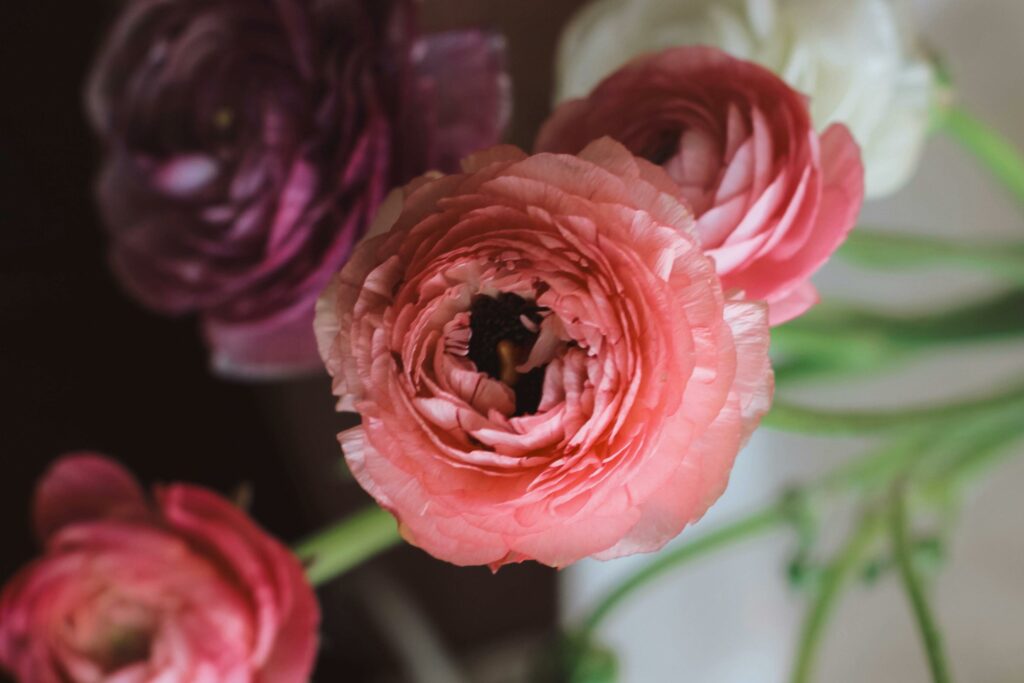
Ranunculus have become something of a connoisseur’s choice within the trend — their tightly packed, papery-thin petals arranged in concentric rings are, somewhat ironically, easier to convince in paper than they are to keep looking fresh as an actual cut flower, which wilts within days of being cut. Many paper florists consider a well-made ranunculus one of the clearest signals of a maker’s skill level.
Anemones have surged in popularity for a different reason: their construction is comparatively simple — a handful of broad, simple petals around a bold, dark center — which makes them a favorite both for beginners learning the craft and for professional makers who want a graphic, modern silhouette rather than a fussy, layered one.
Poppies bring a similar simplicity but trade the anemone’s dark center for a dramatic color contrast between thin, crepe-like petals and a textured black or dark center, often built from clipped paper fringe, making them a favorite for bouquets that want one dramatic, colorful focal bloom rather than an evenly distributed arrangement.
Beyond these headline flowers, wildflower-style fillers — small cosmos, paper baby’s breath, loosely constructed sprigs — round out fuller, garden-style bouquets, providing the visual texture and looseness that keeps an all-paper bouquet from feeling too stiff or composed.
Three Aesthetic Camps
Not everyone making or commissioning paper bouquets is chasing the same look, and the trend has split into a few recognizable aesthetic camps.
The first, and by far the most commercially dominant, is the realistic-botanical camp — bouquets built to be mistaken, at a glance and often even up close, for fresh flowers. These are the most technically demanding to produce, requiring hand-shading, veining, and careful petal-by-petal shaping, and they command the highest prices in the commission market precisely because of the skill and time involved.
The second is a stylized or whimsical camp, which makes no attempt to fool the eye and instead leans into paper’s artificiality on purpose — exaggerated proportions, saturated non-natural colors, oversized blooms, sometimes combined with fantastical elements no florist could ever offer, like flowers in impossible color combinations or paper butterflies woven through the stems. This camp tends to appeal to couples planning a wedding that is deliberately playful or unconventional rather than traditionally romantic.
The third is a more restrained, architectural camp built primarily from cardstock rather than crepe paper, favoring crisp origami-style folds over soft curls. This camp draws more directly from Asian paper-folding traditions and tends to attract couples with a minimalist or modern design sensibility, pairing paper bouquets with clean-lined stationery and decor rather than the lush, garden-party aesthetic more associated with the realistic camp.
Color, Freed From Nature
One of the quieter but more significant appeals of paper flowers is that they are entirely unconstrained by what a plant can actually produce. A rose only comes in the colors a rose can grow; a peony has a narrow, specific palette dictated by its genetics. Paper has no such limit, and colorists working in the medium have used that freedom to push the trend toward a handful of recognizable palettes.
A rust-and-terracotta palette, often paired with deep sage or olive greenery, has become closely associated with autumn weddings and has the particular advantage, for a paper maker, of being nearly impossible to source reliably in fresh flowers at that saturation. A dustier, more muted palette — mauve, dusty blue, faded rose — echoes the currently fashionable dried-flower look without any of the brittleness or fragility of actual dried stems. Bolder makers have leaned into deep jewel tones, emerald and burgundy and plum, for evening or non-traditional weddings where a paler palette would read as an afterthought. And for couples who want the drama of paper’s construction and permanence without color becoming a talking point of its own, an all-white or ivory monochrome bouquet remains a popular, classic choice, relying entirely on the sculptural texture of layered petals rather than color contrast to make its impression.
The Commission Economy
As demand has grown, a genuine artisan marketplace has formed around paper bouquets, and it operates with its own informal but fairly consistent pricing logic. A simple bouquet built from a handful of easier flowers — anemones, poppies, filler blooms — sits at the lower end of the market. A full bridal bouquet built around realistic peonies or garden roses, with hand-shaded petals and a properly finished, ribbon-wrapped handle, sits meaningfully higher, and the most elaborate, fully botanical commissions — the ones built to be handed to a photographer and mistaken for fresh flowers in every shot — command the highest prices of all, reflecting the dozens of hours a single bouquet can take to construct.
What separates a skilled maker from a merely competent one, in the eyes of experienced buyers, tends to come down to a few tells: whether petals are individually shaded or uniformly colored, whether the maker varies petal size and curl within a single bloom rather than making every petal identical, whether the greenery is thoughtfully integrated rather than an afterthought, and whether the overall silhouette has the slightly asymmetrical looseness of a real bouquet rather than the too-perfect symmetry that gives away a beginner’s work.
Learning the Craft Yourself
For those inclined to make their own rather than commission one, paper floristry is a genuinely learnable skill, though the learning curve varies enormously depending on which flower a beginner starts with. Simpler flowers — anemones, poppies, loose wildflower fillers — are realistically achievable within a single afternoon of practice for someone with no prior experience. Peonies and garden roses, by contrast, tend to humble first-time makers; the gap between a template photo and a first attempt is usually wide, and most experienced paper florists describe their own early bouquets as noticeably rougher than what they can produce now, often keeping their first attempts as a kind of before-and-after record of the craft’s genuine learning curve.
The most common beginner mistakes are fairly consistent across accounts: cutting every petal the exact same size and shape, which flattens the visual depth a real flower has; under-shaping petals, leaving them flat rather than cupped or curled; and rushing the stem assembly, which results in a bouquet that looks fine held still but falls apart or droops when actually carried. Patience with the shaping stage — the cupping, curling, and layering of individual petals — tends to be the single largest factor separating a bouquet that reads as handmade-charming from one that reads as convincingly botanical.
A full bouquet, for a first-time maker working evenings around other commitments, realistically takes several sessions spread across a week or two rather than a single sitting, and most people attempting their first bridal-scale bouquet are advised to start well in advance of any deadline, precisely because the temptation to rush the final assembly is where quality most often suffers.
Living With a Paper Bouquet
The trend’s central promise — that a paper bouquet, unlike a fresh one, is built to last — comes with a few caveats that keep it from being entirely maintenance-free. Prolonged direct sunlight will fade dye and paint over a period of years, so long-term display away from a sun-facing window preserves color considerably longer. High humidity is the other real enemy of a paper bouquet, since crepe paper in particular can lose its elasticity and begin to droop or sag in damp conditions, which makes a paper bouquet a poor choice for permanent display in, say, a steamy bathroom, however charming it might look there otherwise. Cleaning is a gentler affair than one might expect — a soft brush or a hairdryer set to a cool, no-heat airflow removes dust far more safely than any water-based cleaning, which can warp or discolor the paper.
Kept reasonably out of direct sun and away from damp air, a well-constructed paper bouquet does genuinely hold up for years, even decades, which is precisely the point. It is not a flower pretending to be permanent. It is a permanent object that happens to look like a flower — and for a growing number of people planning the most photographed day of their lives, that distinction has become the whole appeal.
The Lasting Appeal
It would be easy to file paper flower bouquets under the same broad heading as other wedding-industry trends that rise and recede with the algorithm — a look that photographs well for a season and then quietly disappears. But the craft’s actual history argues against that reading. Paper flowers have resurfaced, in one cultural form or another, for well over a century, each time responding to some combination of scarcity, sentimentality, and a desire for beauty that doesn’t have an expiration date. The current revival, driven by social media visibility and a generation of brides more comfortable breaking from floral tradition than any before it, may be the most visible chapter this craft has ever had. But it is, in a real sense, simply the newest telling of a very old story: that the flowers we make with our own hands have always had a way of outlasting the ones that simply grow.