
There’s a moment that catches many people off guard when someone they love passes away in Hong Kong: standing in a flower shop, phone in hand, trying to decide what to send to a funeral in the next 24 hours. You’re grieving, you’re pressed for time, and suddenly you need to know the difference between a wreath and a flower stand, which colors are respectful, and whether your Chinese message on the ribbon says what you think it says.
This guide exists for that moment. Not as a checklist, but as a walk-through of what’s actually happening culturally when flowers arrive at a Hong Kong funeral — and how to get it right without second-guessing yourself.
The Flower Stand: Hong Kong’s Own Tradition
If you’ve ever walked past a funeral parlour in Kowloon or Hong Kong Island, you’ve likely seen them: towering flower stands, sometimes two or three storeys tall, lined up along the street outside. These are called 花牌 (fa pai), and they’re something you won’t quite find anywhere else in the same form. Traditionally built on bamboo frames and dressed in paper or silk blooms, they’re sent by companies, clan associations, and extended family networks as a public statement — this person mattered, and their community showed up.
If you’re representing a business or a large family group, a flower stand is often the expected gesture. It’s less about personal sentiment and more about visible, collective respect.
Wreaths, Baskets, and the Personal Touch
For most individual mourners — friends, coworkers, neighbours — the more common choice is a wreath (花圈) or a flower basket (花籃). Wreaths are typically displayed standing near the funeral hall entrance, ribbon draped across with your name and a short line of condolence. Baskets are smaller, easier to arrange on short notice, and a practical option when you’re sending flowers from a distance or simply need something ready quickly.
Neither is more or less appropriate than the other — the choice usually comes down to your relationship to the deceased, your budget, and how much lead time you have.
Color Is Doing More Work Than You Think
Here’s where a lot of visitors and even some locals get tripped up: the color of the flowers you send carries real weight in Hong Kong’s funeral customs, arguably more than the type of flower itself.
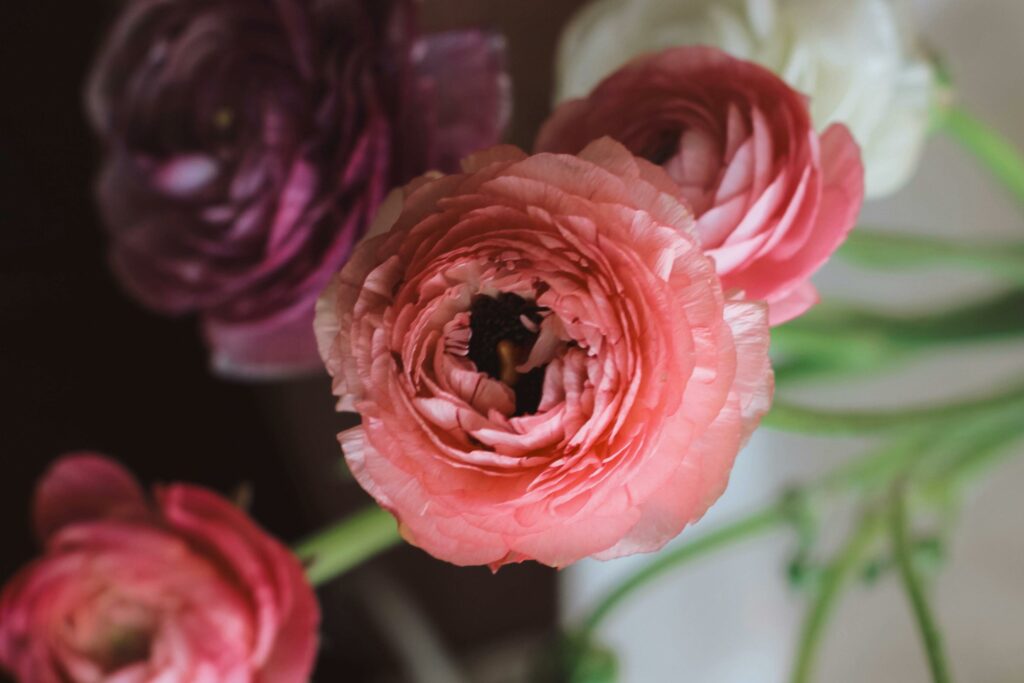
White is the default and the safest choice — chrysanthemums, lilies, orchids, all in white, are a formula you genuinely can’t go wrong with. Yellow works too, often paired with white. Muted tones like pale blue or soft purple can round out an arrangement. But red and pink are off the table entirely. These colors belong to weddings and Lunar New Year, and showing up with them at a funeral reads as a jarring, even disrespectful, mismatch — regardless of intent.
Chrysanthemums deserve a special mention here, because their meaning shifts depending on where you are. In much of the West, they’re a cheerful, all-purpose flower. In Hong Kong and across Chinese culture, they’re specifically associated with mourning — which is exactly why they show up so consistently at funerals here.
What Not to Send
A few things are worth avoiding outright:
Potted plants are one of them. It sounds harmless, even thoughtful — a living plant instead of cut flowers that will wilt. But in Cantonese, the word for “pot” carries an unfortunate homophone association tied to prolonged illness, and many families would rather you skip it. If you’re unsure, a quick check with the florist or a family member saves an awkward moment.
Peonies and other flowers strongly tied to celebration and prosperity should also be avoided — again, the wrong occasion for the wrong flower. And in a small, enclosed funeral hall, it’s worth thinking twice about heavily fragrant arrangements, which can become overwhelming rather than comforting in that setting.
Getting the Timing and Message Right
Hong Kong funerals often come together quickly — sometimes with only a day or two of notice — so florists who specialize in this kind of work are usually set up for fast turnarounds, including same-day delivery in many cases. Still, giving at least 24 hours’ notice is the safer bet, both for availability and for the florist to properly prepare a wreath or stand rather than rush it.
The ribbon message matters too. Common phrases like 沉痛悼念 (in deep mourning) or 敬輓 (respectfully mourned), paired with your name, are the standard format. You don’t need to overthink the wording — florists experienced in funeral arrangements will usually have this ready to go, in Chinese, English, or both, depending on the family’s background.
It’s also worth a quick call to the funeral parlour itself — Hong Kong Funeral Home, Universal Funeral Parlour, Diamond Hill, Kowloon Funeral Parlour, and others each have their own delivery logistics, and confirming details in advance avoids last-minute confusion.
When You’re Not Sure What’s Expected
Customs shift depending on the family’s background — Buddhist, Taoist, Christian, or a blend shaped by dialect group and generation. Some families place more emphasis on cash gifts (帛金) than flowers; others expect both. If you’re at all unsure, it’s completely normal to ask the family, a mutual friend, or the event organizer directly. Nobody will think less of you for checking — it’s far more common than guessing wrong.
The Short Version
If you remember nothing else: white or yellow chrysanthemums, lilies, or orchids, delivered a day ahead if you can manage it, with a simple ribbon message and no red, pink, or potted plants in sight. That combination will serve you well in almost any Hong Kong funeral setting, and it gives you one less thing to worry about while you’re already carrying enough.