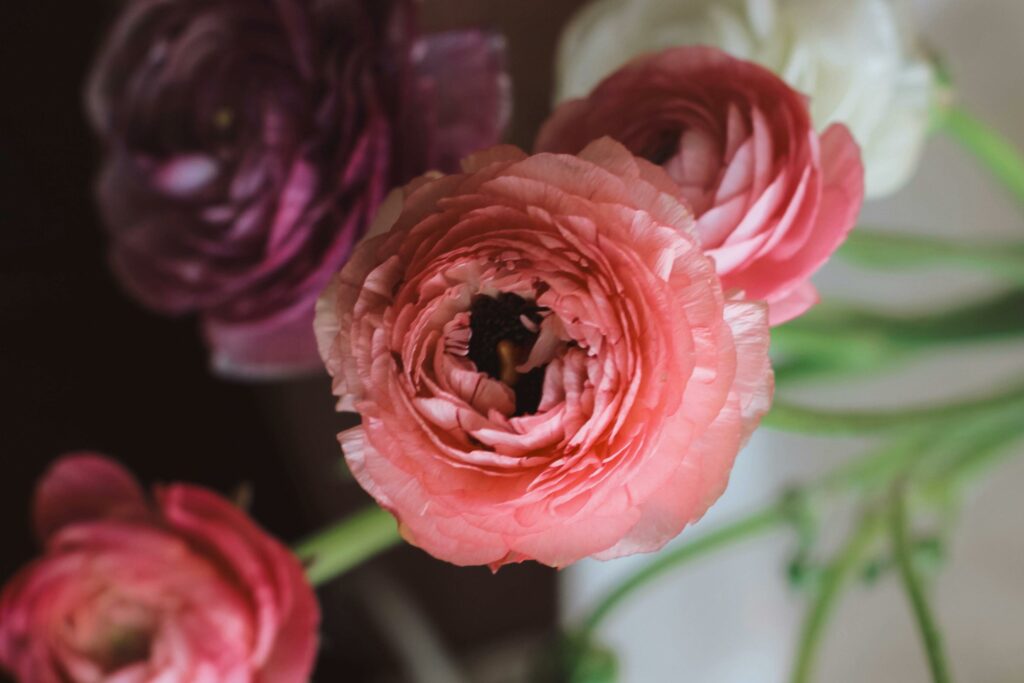

For those who have embraced the slow flower movement, the journey matters as much as the bloom. These carefully curated flower farms across the globe represent more than agricultural ventures; they are sanctuaries of biodiversity, keepers of heirloom varieties, and testaments to the belief that flowers should be grown with intention, harvested with care, and celebrated for their seasonal authenticity.
Europe
Terre de Fleurs, Provence, France
Nestled in the lavender-scented hills outside Grasse, Marie Dubois tends to three hectares devoted entirely to scented heritage roses and forgotten French cultivars. Her farm operates on principles established by her great-grandmother in 1923, using no synthetic inputs and relying solely on companion planting and natural pest management. The farm specializes in Gallica roses, Damasks, and Alba varieties that were common in French gardens before the hybrid tea rose revolution. Visitors can walk through the cutting garden on weekend mornings during May and June, when Marie offers workshops on creating naturally scented bouquets and understanding the language of old roses.
De Bloementuin, Friesland, Netherlands
In the flat, wind-swept landscape of northern Netherlands, Willem and Saskia van der Meer have transformed former dairy pastures into a celebration of Dutch botanical heritage. Their four-hectare farm focuses exclusively on tulip species and historic cultivars that predate the modern Dutch bulb industry. Rather than the uniform, large-flowered varieties found in commercial fields, they grow delicate botanical tulips, Rembrandt tulips with their virus-induced color breaks, and Parrot tulips with feathered petals. The farm maintains a seed bank of over 200 tulip varieties, some dating back to the 17th century tulip mania period. Their season runs from late March through early May, and they supply florists across Europe who seek unusual bulbs for naturalistic arrangements.
Petal & Stem, Cornwall, England
On the rugged southwestern coast of England, former chef Imogen Clarke operates a one-acre flower farm that could easily be mistaken for a cottage garden run wild. Her specialty is British natives and naturalized species that thrive in the maritime climate: sea thrift, Cornish bluebells, wild honeysuckle, and native orchids. Imogen grows no flowers under glass, allowing her selection to be entirely dictated by what flourishes in Cornwall’s unpredictable weather. She’s become particularly known for her winter offerings, unusual in the cut flower world, when she harvests hellebores, winter-flowering viburnums, and branches of lichen-covered hawthorn. Her aesthetic celebrates the windswept, slightly disheveled beauty of coastal flora.
North America
Burnt Rock Farm, Vermont, USA
In Vermont’s Northeast Kingdom, Alyssa Meadows runs a high-elevation flower farm dedicated to cold-hardy perennials and short-season annuals. The growing season here lasts barely four months, but Burnt Rock has turned this limitation into expertise. Alyssa grows varieties specifically bred for northern climates, including Icelandic poppies, lupines, sweet peas, and an impressive collection of hardy geraniums. She’s also pioneered techniques for extending the season using minimal heating in uninsulated hoop houses, allowing her to provide fresh-cut flowers from late April through early November. The farm has become a teaching ground for northern growers, hosting workshops on season extension, succession planting, and breeding flowers for cold tolerance.
Pétales Sauvages, Quebec, Canada
Just outside Montreal, Marguerite Fontaine operates a French-language flower farm that focuses exclusively on species native to the St. Lawrence River valley and surrounding boreal forests. Her mission is part botanical preservation, part artistic expression. She grows wild lupines, Joe-Pye weed, New England asters, cardinal flowers, and dozens of native wildflowers that have become rare as agriculture has intensified. Marguerite works with local conservation organizations to source seeds ethically and has created a demonstration garden showing how native flowers can be incorporated into home landscapes. Her bouquets have an untamed, meadow-gathered quality that has influenced a generation of Quebec florists to reconsider what a wedding bouquet might look like.
Thistle & Yarrow Farm, Oregon, USA
In the Willamette Valley, the creative partnership of Elena Vasquez and Jordan Chen has produced one of North America’s most innovative small-scale flower operations. Their two acres focus on unusual foliage, textural elements, and flowers in unconventional colors: chocolate cosmos, nearly black hollyhocks, lime green zinnias, and burgundy-leafed dahlias. They’ve rejected the pastel palette that dominates American wedding floristry in favor of moody, dramatic combinations. Thistle & Yarrow also experiments with preserving flowers using traditional techniques, including glycerin preservation of foliage, air-drying of seed heads, and bunching of everlasting flowers. They’ve created a year-round business model unusual for seasonal growers by offering both fresh summer flowers and preserved winter arrangements.
Asia
Hana no Sato, Kyoto Prefecture, Japan
The Tanaka family has grown flowers for traditional ikebana arrangements for six generations on their small farm in the hills outside Kyoto. Their specialty is seasonal branches and blossoms central to Japanese floral art: plum and cherry blossoms in spring, hydrangeas and iris in early summer, chrysanthemums in fall, and pine and winter berries as the year ends. The farm maintains several ancient cherry trees whose blossoms are particularly prized by ikebana masters for their form and color. Cultivation practices follow traditional Japanese methods, with careful attention to the angle and shape of each branch cut. The Tanakas supply a select group of ikebana schools and temples, and their materials are considered especially appropriate for tea ceremony settings.
Blooms of the Himalayas, Darjeeling, India
At an elevation of nearly 2,000 meters in the Himalayan foothills, Priya Sharma grows flowers that thrive in the region’s unique climate of warm days, cool nights, and monsoon rains. Her specialty is flowers rarely seen in commercial cultivation: Himalayan blue poppies, primulas, rhododendrons, and native orchids. The farm operates as both a commercial venture and a conservation project, working to preserve local botanical diversity as climate change threatens mountain ecosystems. Priya has trained local women in flower cultivation and arrangement, creating a cooperative that supplies hotels and restaurants in Darjeeling and Sikkim. The farm’s aesthetic draws on both British colonial garden traditions and indigenous Nepali and Tibetan flower use.
Australia & New Zealand
Southern Blooms, Tasmania, Australia
In Tasmania’s cool, maritime climate, Rebecca Walsh has built a flower farm that specializes in what won’t grow well on the Australian mainland. Her focus is flowers that need cold winters and moderate summers: sweet peas, ranunculus, anemones, and especially peonies. Southern Blooms has become one of the southern hemisphere’s premier peony growers, cultivating over 80 varieties and supplying the off-season market in the northern hemisphere. Rebecca has also championed Australian native flowers in her mixed bouquets, combining European cultivars with native wattle, banksias, and eucalyptus foliage. Her work has helped shift Australian flower design away from imported Dutch flowers toward locally grown alternatives.
Wildflower Meadows, Central Otago, New Zealand
In New Zealand’s driest region, Sarah and Tom Morrison practice what they call “regenerative flower farming” on land that was previously used for intensive sheep grazing. They’ve removed fences, allowed native grasses to return, and planted native New Zealand flowers alongside introduced species that naturalize well without becoming invasive. Their mix includes native kowhai, flax, and astelia with cottage garden favorites like cosmos, calendula, and nigella. The farm operates on no-till principles, uses no irrigation, and relies entirely on rainfall. The result is a landscape that looks more like a flowering meadow than a traditional farm, and their bouquets reflect this wild aesthetic.
South America
Flores del Valle, Mendoza Province, Argentina
At the foot of the Andes, Catalina Ruiz grows flowers organically among her family’s vineyard rows. Her approach combines traditional Argentine garden flowers with the business model of her family’s winery. The flowers, including roses, lavender, and herbs, serve both as beneficial plantings for the vines and as a separate product line. Catalina supplies florists in Buenos Aires with seasonal flowers and has developed a line of dried flower arrangements using lavender, statice, and strawflowers. Her farm demonstrates how flower cultivation can integrate with other agricultural systems, and she’s become an advocate for companion planting and biodiversity in Argentine wine country.
Africa
Cape Flora Collective, Western Cape, South Africa
This cooperative brings together a dozen small-scale growers in the Cape Floral Kingdom, one of the world’s most biodiverse regions. The collective focuses on South African native flowers, particularly proteas, leucadendrons, and ericas, grown sustainably by farmers committed to conservation. Many members grow flowers on land adjacent to protected areas, serving as buffer zones that preserve natural habitat while providing income. The collective has established relationships with international florists interested in South African natives and has pioneered techniques for growing fynbos flowers with minimal water input, crucial in a drought-prone region. Their model shows how commercial flower cultivation can support rather than threaten biodiversity.
Visiting and Supporting These Farms
Most of these farms welcome visitors during their growing seasons, though it’s essential to contact them in advance. Many offer workshops, farm tours, or flower arranging classes. For those who can’t visit in person, several ship flowers or offer subscription bouquet services to nearby cities.
Supporting niche flower farms means accepting seasonality, celebrating imperfection, and understanding that these flowers often cost more than supermarket bouquets because they reflect the true cost of sustainable cultivation. It means choosing flowers grown in soil rather than shipped across continents, and valuing the story behind each bloom as much as its appearance in a vase.
The slow flower movement asks us to reconsider our relationship with flowers, to see them not as commodities but as connections to place, season, and the people who tend them. These farms around the world are keeping that vision alive, one carefully grown bloom at a time.